
Products · Lifting And Spreader Beams
LIFTING BEAMS & SPREADERS
Adjustable Lifting Beam
Flexible Heavy Lifting for Different Pick-Up Spans
Engineered lifting beams for metal, concrete, dies and machinery with adjustable pick-up points, telescopic or modular spans.
- Up to 200 t
- Product-family capacity
- Project-specific
- Lifting span
Loading frame
Product introduction
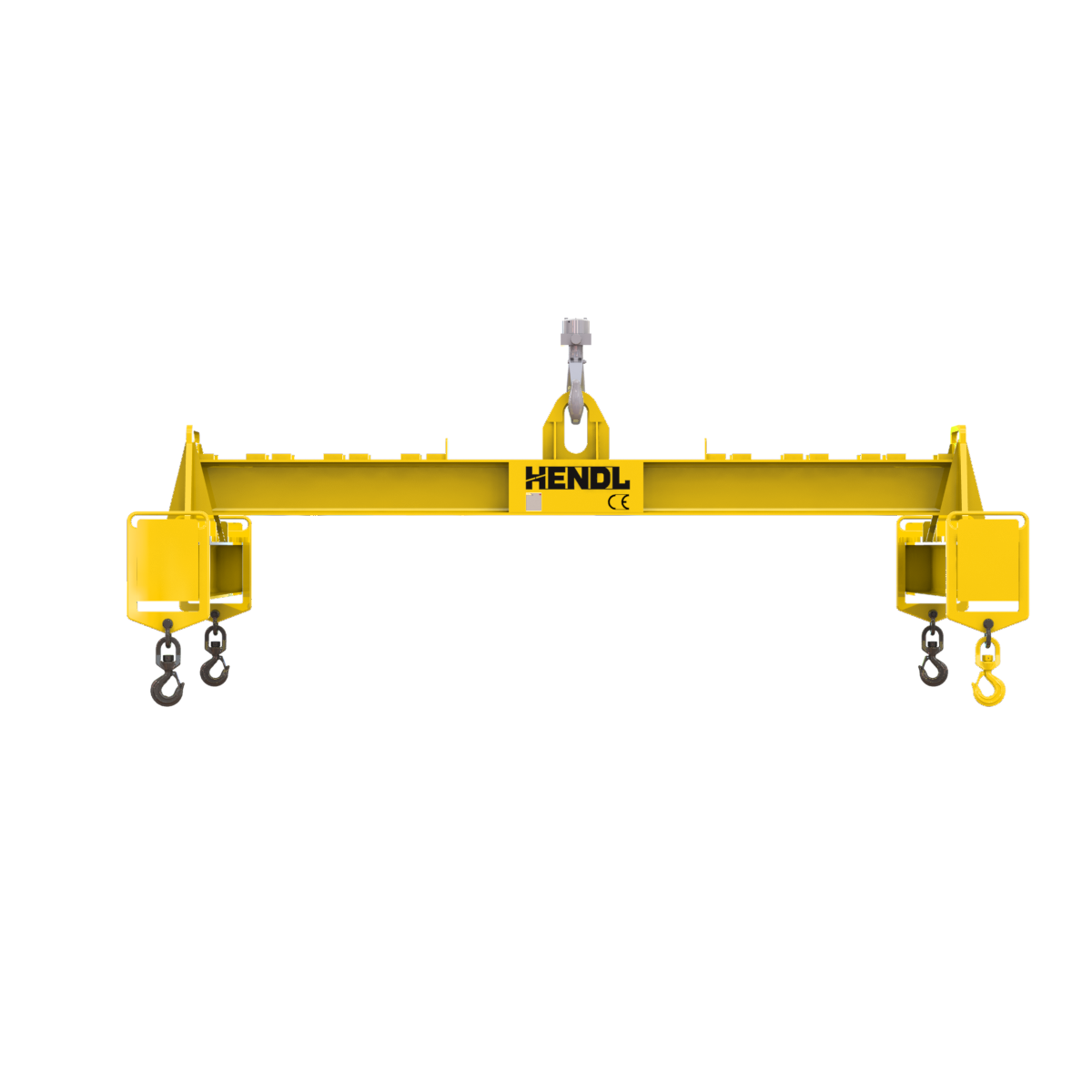
HENDL Adjustable Lifting Beams are engineered below-the-hook devices for lifting industrial loads of different lengths, geometries and centres of gravity from suitable connection points. The product family includes fixed-length beams with repositionable lower lifting points, beams with telescopic spans and bolted modular spreader arrangements as distinct configurations. Solutions can be developed for metal products, precast concrete, machinery, dies and other specialised loads. The published product-family capacity extends up to 200 metric tonnes; higher capacities require individual engineering assessment.
Standard Capacity And Dimensions
Up to 200 t is the upper capacity class of the product family, not an identical working load limit for every span, beam length or lifting-point arrangement. The permitted load is established for each configuration from the span and load distribution and may be expressed in a project-specific capacity-versus-span chart. Manual adjustments are performed only when the load is not suspended. Powered adjustment or levelling with a suspended load is possible only in a specially engineered configuration incorporating the required mechanical arrangements, interlocks and safety assessment; it is not a blanket operating permission. Beam length, minimum and maximum span and other dimensions are project-specific.
Working Principle
On a fixed-length adjustable beam, the lower pick-up connections are positioned to match the load and mechanically secured. A telescopic beam changes its working span through a dedicated manual, electric or hydraulic mechanism, while a modular beam obtains its span by assembling compatible bolted sections. These are separate design principles, not simultaneous features of every beam. Top rigging may use a single lifting eye, two-leg sling arrangement or a twin-hook crane configuration. Lower connections may include hooks, shackles, chains or slings. Two-point, four-point and multi-point lifting layouts are engineered for the actual load.
Selection
Selection begins with the payload mass and centre of gravity, the number and coordinates of lifting points, required span range, available crane headroom, crane hook quantity and geometry, selected rigging and operating duty. For off-centre loads, the top lifting position, lower pick-point arrangement or purpose-engineered mechanical or powered load-levelling system can be evaluated. Hot environments, protective contact finishes and low-headroom requirements are assessed as part of the project definition.
Safety and engineered configuration options
Configuration-specific provisions may include secured locking pins, position markings, capacity-versus-span charts, telescopic mechanical end stops, powered travel limit switches, interlocks preventing unauthorised adjustment under load, emergency stopping, identification and product-specific operating/test documents, replaceable wear bushings, position sensors, holding arrangements on power loss and overload or drive-torque protection. Engineered options include interchangeable lifting eyes and shackles, swivel safety-latch hooks, chain or sling top rigging, alternative lower attachments, bolted modular extensions, electric or hydraulic telescopic actuation, multi-point lifting, off-centre load levelling, reduced headroom, twin-crane-hook layouts, compact transport arrangements, hot-environment protection and integration of suitable magnetic or vacuum lifting heads. These are not standard features on every beam. Any magnetic or vacuum head requires its own load-retention and loss-of-power assessment.
Technical Figures For A Quote
For a quotation, provide the load type, minimum and maximum mass, dimensions, centre-of-gravity location, number and coordinates of pick-up points, required minimum and maximum span, crane hook type and quantity, available hook-to-load headroom, preferred manual or powered adjustment, whether adjustment under a suspended load is required and environmental conditions. Load drawings, a lift plan, crane information and operating frequency will support the engineering review.
Questions
What types of adjustable lifting beam are available?
Fixed-length beams with adjustable lower lifting positions, telescopic beams and bolted modular spreader beams can be engineered as separate configurations. Manual, electric or hydraulic adjustment is selected according to the application.
Is the 200 t capacity available at every beam span?
No. Up to 200 t describes the product-family maximum. Each beam’s permissible working load depends on the span, top and bottom rigging geometry, forces at the pick-up points and the distribution of the payload.
Can the lifting-point spacing be adjusted while a load is suspended?
Standard manual adjustment is carried out without a suspended load. Powered span adjustment under load must be specifically designed and assessed, including its load path, stability and control interlocks. It must never be assumed safe for every powered beam.
Related Equipment
Quote