
Products · Tilting And Turning
INDUSTRIAL LOAD TURNING SYSTEMS
180° Industrial Load Inverter
Turning dies and heavy components over for maintenance
Custom-engineered dual-axis solution combining 90° tilting and independent 180° rotary-table orientation, designed for same-side loading and retrieval.
- Up to 60 t
- Load capacity
- 90° + 180°
- Two distinct motion axes
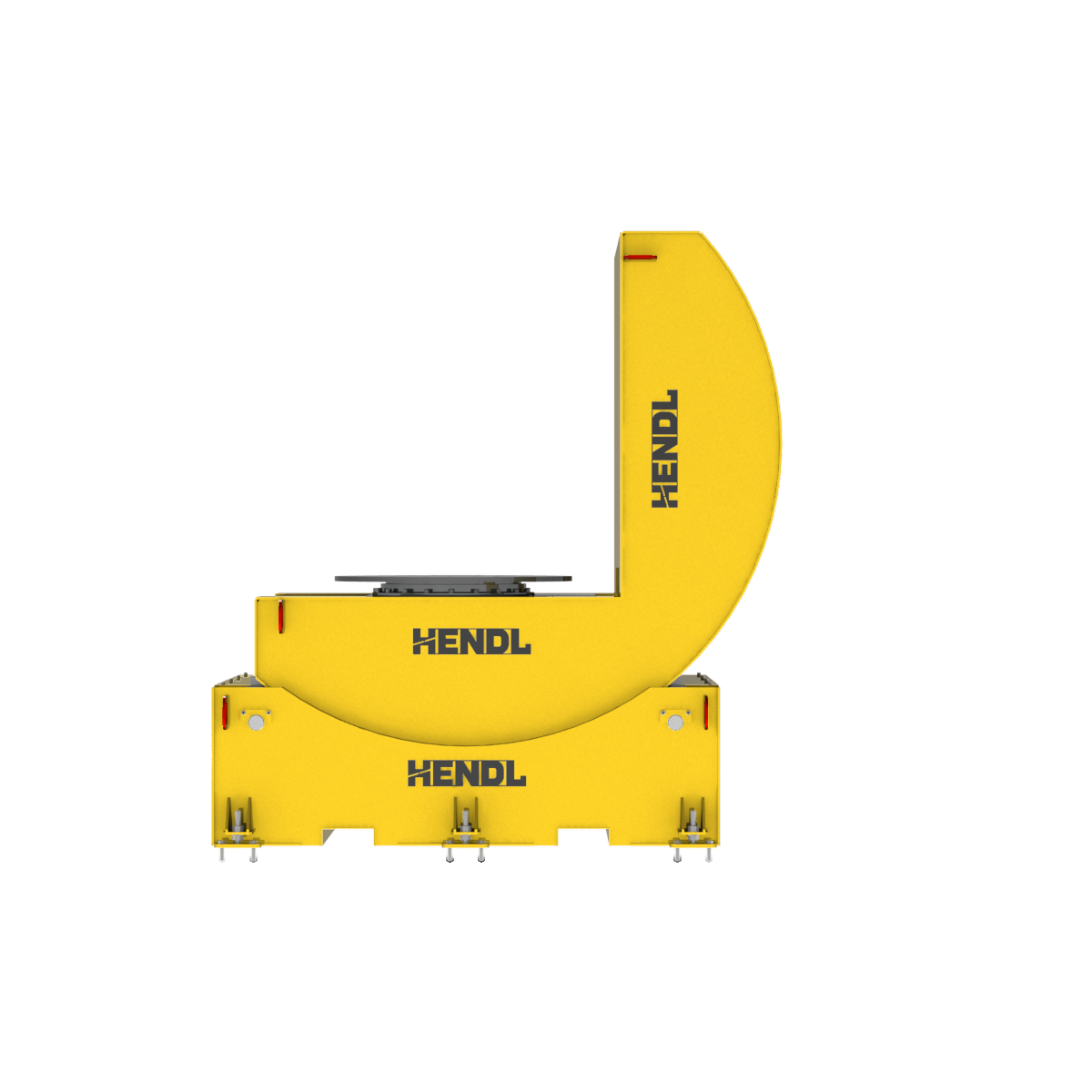
Frame loading
Product introduction
The HENDL 180° Industrial Load Inverter is engineered for turning over dies and heavy workpieces during maintenance, inspection and repositioning. An L/C-shaped tilting frame and an independently motorised rotary table provide two distinct axes of movement at one workstation. With load-specific securing and a suitable motion sequence, a workpiece can be reoriented and retrieved from the same operating side. Separate tooling and restraints can be engineered for metal coils, pallets and sheet-metal packs.
Standard Capacity And Dimensions
The product family is engineered for loads up to 60 metric tonnes, with higher capacities subject to bespoke engineering.
An approximate 60-second cycle is dependent on the model, load geometry and movement sequence; it is not a guaranteed full-cycle time at 60 t for every load.
The 90° tilting motion and the separate 180° table orientation are distinct axes.
Machine footprint, fixture dimensions and permissible load envelope are established for each project rather than presented as a universal standard size.
Working Principle
An electric motor and gearbox first drive the L/C-shaped support frame through approximately 90° of tilt. A separate motor–gearbox drive then indexes the integrated table through 180° about its own axis. With appropriate sequencing and positive load restraint, this combination can present the opposite face of a die or heavy component for maintenance. Same-side loading and retrieval can reduce the need for a second handling area, while access from opposite sides can be accommodated when required by the plant layout. The dual-axis arrangement must not be confused with a single-axis continuous 180° inversion or a rail-mounted transfer system.
Selection
Engineering starts with the actual load mass, length, width, height, centre of gravity, accessible faces, securing points, required initial and final orientation, cycle frequency and operator access envelope. A flat rotary table with load-specific fixing points is the primary support concept; dies, coils and sheet packs can require different fixtures. The frame and rotary table are arranged around the intended material flow to enable same-side handling where the site permits.
Safety and custom engineering options
Load locking points; retaining prisms for coiled material; polyamide, UHMW-PE or polyurethane contact surfaces; tilt end limits and 0°/180° table position sensing; emergency stop, controlled braking and power-loss holding provisions; light curtains or laser area scanners; audible and visual warnings; and sequencing to prevent motion interference can be assessed for the project-specific risk profile. Changeable V-cradles, dedicated fixtures, crane/forklift loading access, conveyor integration, welding-current connection, compact frames, wired/wireless controls, maintenance lockout and recessed floor installation can be engineered as application-specific options.
Technical Figures For A Quote
For a technical quotation, provide the load type (particularly dies or heavy workpieces), maximum mass, dimensions, centre of gravity, securing surfaces, starting and final orientation, same-side handling requirement, loading equipment, daily duty cycle and workstation layout. Drawings, STEP files and required maintenance access areas help define a safe load restraint and motion sequence.
Questions
Can the inverter actually turn a die over for maintenance?
Yes. Where the load can be secured appropriately, the 90° tilt and independent 180° table orientation can be sequenced to expose the opposite face of a die or heavy component. This is not the same mechanism as single-axis inversion; suitability depends on the load geometry and engineered restraint.
Can loading and unloading take place on the same side?
Yes. A principal layout advantage is the ability to orient a suitably secured load so that it can be loaded and retrieved from the same operating side. Two-sided loading and unloading access can also be designed to suit the facility arrangement.
What are the capacity, turning time and standard dimensions?
The published family capacity is up to 60 t, with higher capacities considered as special projects. An approximately 60-second cycle varies by model, load and motion sequence. Table dimensions and the permitted load envelope are project-specific; no single model is assumed to accommodate every 60 t load.
Related Equipment
Quote