
Products · Plate, Slab And Long Product
STEEL MILL LIFTING EQUIPMENT
Mill Roll Lifter
Work Roll & Backup Roll Handling
Mechanical and powered below-the-hook solutions for handling rolling mill rolls, chocks and bearing assemblies.
- Up to 100 t
- Lifting capacity
- Custom-sized
- Roll dimensions
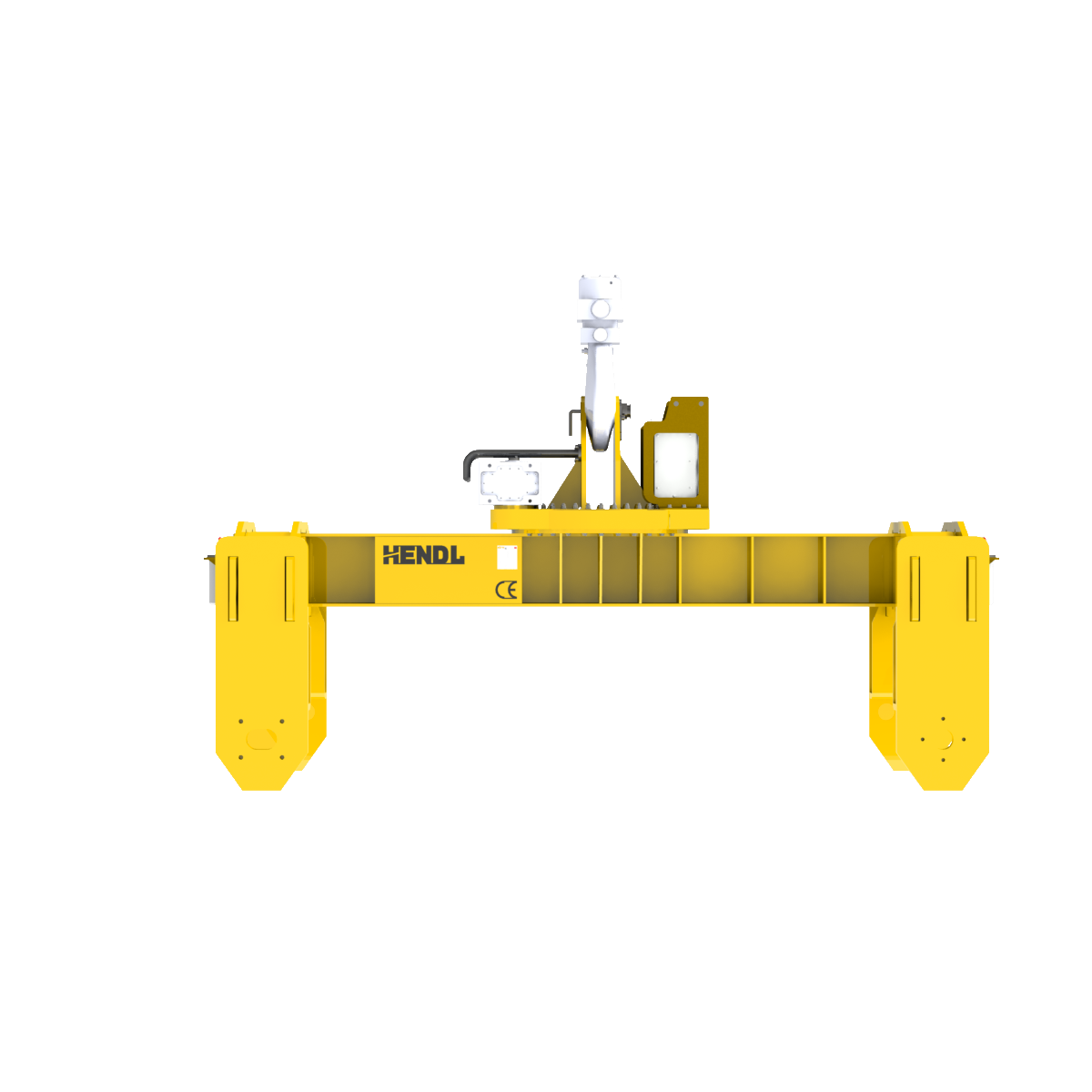
Frame loading
Product introduction
The HENDL Mill Roll Lifter is a family of below-the-hook lifting devices for handling work rolls, backup rolls, bearing chocks and bearing assemblies in steel rolling mills. Mechanical and powered configurations are available for lifting applications up to 100 metric tonnes. Dedicated designs can engage the roll neck, roll body or chock, depending on the roll assembly, lifting process and plant layout.
Standard Capacity And Dimensions
- Lifting capacity
- up to 100 metric tonnes.
- Applications
- work rolls, backup rolls, bearing chocks and bearing assemblies.
- Gripping interfaces
- roll neck, roll body or chock, with dedicated designs.
- Handling
- single rolls, paired rolls and assemblies with or without chocks according to project requirements.
- Actuation
- mechanical or powered.
Powered vertical-axis positioning is a project option.
Dimensions are application-specific; capacities above 100 tonnes are assessed through custom engineering.
Working Principle
The attachment is positioned by an overhead crane at the designated engagement points of a roll or roll-and-chock assembly. Depending on the configuration, mechanical gripping or powered gripping and positioning is used. Different lifting heads can be engineered for roll necks, roll bodies and chocks. Where pin engagement is specified, sensors can monitor correct pin seating; automatic mechanical locking can be incorporated into suitable mechanical designs. Powered configurations may also rotate the complete lifting attachment about a vertical axis for controlled positioning. This is not rotation of the roll about its own axis or a horizontal-to-vertical upending function. Before lifting, the operator verifies engagement and load conditions according to the instructions for the selected model.
Selection
Key selection data include work-roll or backup-roll type, maximum total lifting weight, single- or double-roll handling, roll body and neck diameters, overall roll length, bearing and chock geometry, centre of gravity, crane hook interface, available headroom and duty cycle. All working dimensions are defined for each project. The published 100-tonne capacity is a product-family upper range, not a claim that one unit handles every size and configuration.
Mechanical, powered and custom handling options
Project options include single- and double-roll handling, complete roll-and-chock assemblies, loading and unloading of roll-grinding machines, interchangeable gripping heads and pins, polyamide or similar protective contact surfaces, automatic centring and positioning, parking/maintenance stands and compact low-headroom construction. Where appropriate, designs can incorporate pin-seating detection, automatic mechanical locking, gripping position sensors and limit switches, emergency-stop and crane-control integration, inverter-controlled acceleration/deceleration, audible/visual warnings and engineered load-retention arrangements for power-loss scenarios. These are configuration-dependent solutions, not a standard feature set on every model; the required functions are established through project-specific engineering and risk assessment.
Technical Figures For A Quote
For a technical quotation, provide the roll type (work or backup), quantity and lifting arrangement, individual and total mass, overall length, body and neck diameters, chock and bearing assembly drawings, centre of gravity, intended gripping or pin-engagement points, crane hook dimensions, available headroom and operating duty. Specify any roll-grinding machine loading/unloading, automatic centring, powered positioning and control-system requirements.
Questions
Which mill rolls can be lifted, and what is the capacity?
The HENDL product family covers work rolls, backup rolls, chocks and bearing assemblies in lifting applications up to 100 metric tonnes. Single rolls, paired rolls and assemblies with or without chocks are engineered as separate configurations. Actual capacity and dimensions are established for the selected design; requirements above 100 tonnes can be reviewed as custom engineering.
Can the device engage a roll neck or bearing chock?
Yes. Dedicated lifting heads can be engineered to support or grip roll necks, roll bodies or bearing chocks. Depending on the configuration, options may include sensors for fully seated chock pins and automatic mechanical locking.
Is powered rotation or roll-grinding line automation available?
Powered configurations can provide vertical-axis positioning of the lifting attachment, while custom solutions can address automatic centring and loading/unloading of roll-grinding machines. Vertical-axis positioning does not mean spinning or upending the roll itself. Controls and safety functions are specified for each application.
Related Equipment
Quote