
Products · Plate, Slab And Long Product
CRANE BOTTOM BLOCKS
Motorized Hook Block
Controlled Powered Rotation at the Hook
Inverter-controlled hook rotation with a motor brake for a product family up to 50 tonnes. Reeving and crane interfaces are engineered to order.
- Up to 50 t
- Product-family upper capacity
- Limited / continuous
- Separate rotation variants
Frame loading
Product introduction
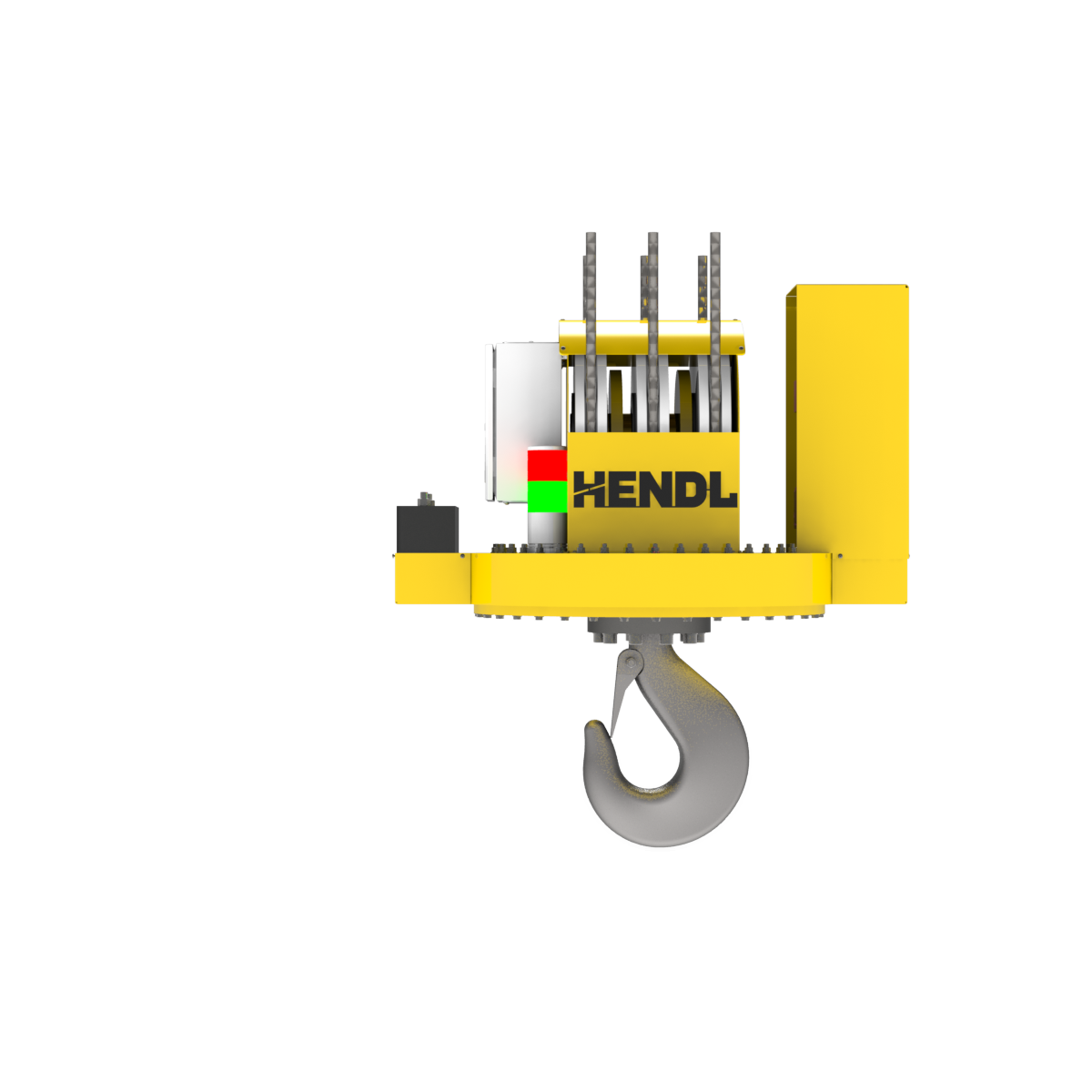
The HENDL Motorized Hook Block family provides engineered powered-rotation solutions for controlled orientation of loads suspended from a crane hook. The family covers applications up to 50 tonnes; this is not the working load limit of every variant or of the unit shown. A new rope-reeved bottom block, a bottom block adapted to an existing crane and a separate hook-on rotator for suitable applications are distinct configurations. Powered rotation acts about the lower hook’s own vertical axis; rotation of the entire sheave block is not implied.
Standard Capacity And Dimensions
The confirmed 50-tonne figure is the upper capacity of the HENDL-P027 product family, not the marked WLL of an individual block, hook or pictured unit. Rotation speed in rpm, motor rating, sheave and rope dimensions, overall block dimensions, operating temperature and duty class are not confirmed as universal fixed specifications; they are defined per project. Unlimited rotation is not available on every configuration. Powered hook rotation must not be presented as preventing rope twist in all conditions. Safety and engineered options apply only when specified and validated for a particular design; no completed testing or certification is claimed.
Working Principle
The crane hoisting system carries the load through the bottom block and hook connection. A three-phase AC-powered geared motor drives the lower hook about its vertical axis through a chain-and-sprocket transmission. The operator commands rotation by radio remote control, while an inverter allows rotation speed to be adjusted to the application. A motor brake is used to hold rotational position. Limited-angle and continuous-rotation solutions are separate variants; travel limits, power supply arrangements and cable management are engineered for the selected configuration. The crane’s hoist holding brake is a separate safety function from the powered hook-rotation brake.
Selection
Selection starts with crane rated capacity, rope diameter and number of supporting rope parts, sheave count and arrangement, hook dimensions, existing bottom-block geometry and available headroom. Load mass, centre of gravity, rotational inertia, requested turning angle, operating duty, environment and control interface also influence the design. A new bottom block, an existing-crane retrofit and a self-contained hook-on rotator are alternative implementation routes rather than standard features fitted to one unit. Steelmaking and heavy-duty overhead cranes are principal application areas.
Powered hook rotation, safety and engineered options
Depending on configuration, available safety provisions may include a motor brake, mechanical rotation stops, electrical limit switches, angular position sensing and feedback, a forged hook with safety latch, emergency-stop and crane-control interlocks, mechanical anti-rotation lock, integrated load measurement and motor-temperature monitoring. Project-engineered options can include low-headroom construction, slip-ring power transfer to a below-hook device, single or twin hooks, remote-operated hook latch, special sheave and reeving arrangements, high-temperature or corrosive-environment protection, clevis connections, and bespoke hook geometry, materials or bearings. These are not standard features of every variant and are not assumed to be mutually compatible; safety functions are engineered for the actual crane and load.
Technical Figures For A Quote
For a technical quotation, provide maximum load mass, load geometry and centre of gravity, together with the desired rotation function. Include crane type and rated capacity, hook and existing bottom-block drawings, sheave count, reeving and rope diameter, available headroom and any retrofit restrictions. Specify limited or continuous rotation, required speed control, available three-phase AC supply, radio-control integration, duty cycle and ambient conditions. Identify any requested brake and rotation lock, sensors, load weighing, slip ring, special hook or corrosion/heat protection.
Request a technical quotation for a Motorized Hook Block
Questions
What is the lifting capacity of a Motorized Hook Block?
The confirmed upper capacity of the HENDL-P027 family is 50 tonnes. It does not define the working load limit of every motorized bottom block or of the pictured model. Each unit’s WLL is specified from its crane interface, hook, sheave and reeving arrangement, structural design and operating conditions.
Can the hook rotate continuously, and how is speed controlled?
Limited-angle and continuous rotation are offered as separate engineered configurations. In a suitable model, a geared motor and chain-and-sprocket drive rotate the lower hook about its vertical axis, with inverter-adjustable rotation speed. Travel limits, power transfer, controls and braking depend on the selected arrangement. Unlimited rotation and complete rope-twist prevention are not claimed for every model.
Can a motorized hook block be installed on an existing crane?
A new bottom block compatible with an existing crane, or a separate hook-on rotator for a suitable application, may be evaluated. Fit is not automatic: rope reeving, sheave geometry, hook connection, headroom, electrical supply, control system and crane safety functions must be reviewed before an integration scope is agreed.
Related Equipment
Quote