
Products · Plate, Slab And Long Product
PLATE, SLAB & LONG PRODUCTS
Slab Tong
Engineered Mechanical Gripping for Slab Handling
Crane-suspended scissor lifting tongs for steel, aluminium and copper slabs, with project-specific hot-duty variants.
- Up to 150 t
- Product-family capacity
- Up to 800°C
- Purpose-designed hot-duty versions only
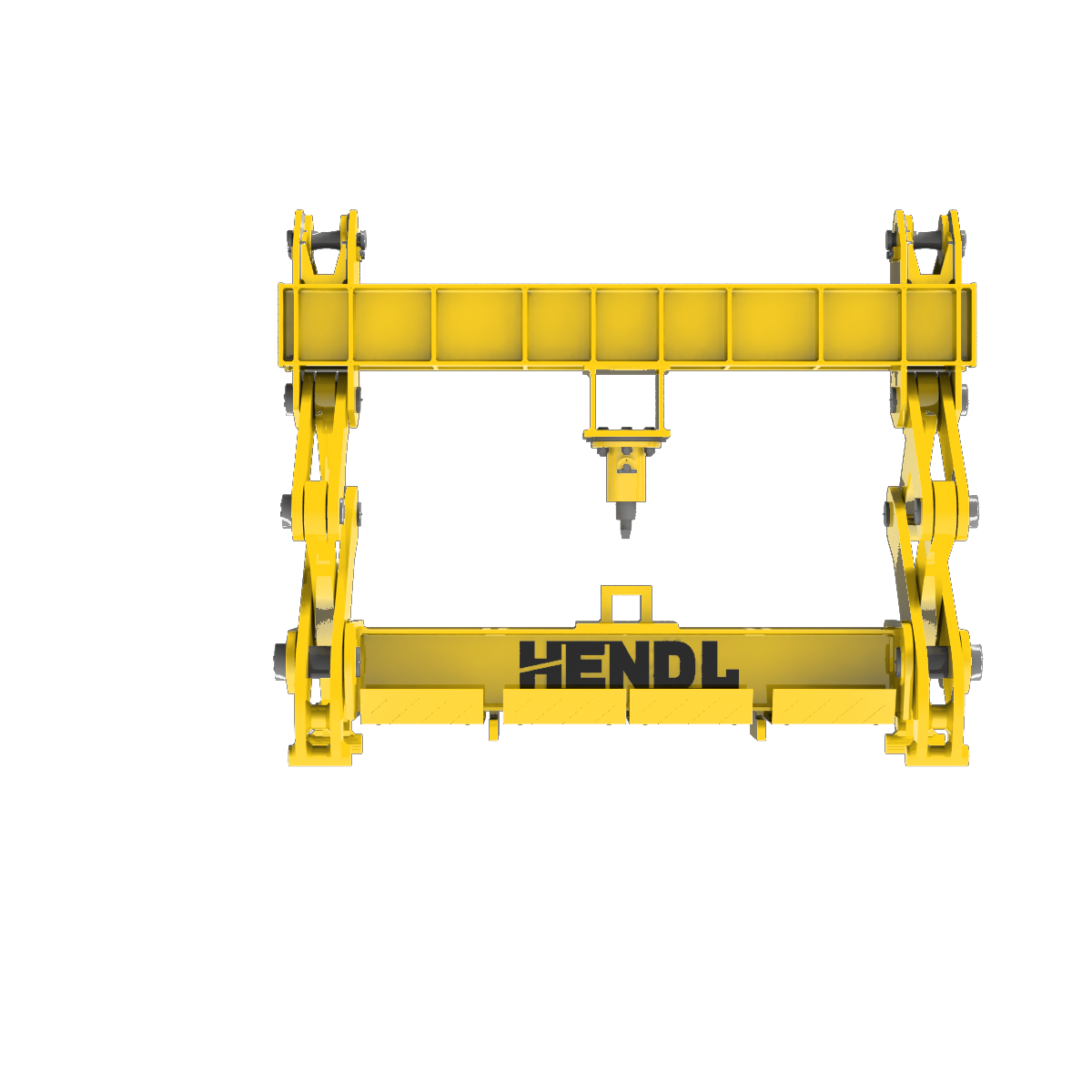
Frame loading
Product introduction
The HENDL Slab Tong is a family of crane-suspended lifting grabs designed to grip steel, aluminium and copper slabs at their side faces and carry them in a horizontal orientation. The primary design converts hoisting force into gripping force through mechanical scissor arms, with an automatic latch coordinating the handling sequence. Product-family capacity extends up to 150 metric tonnes; higher capacities require dedicated engineering. Single slabs, stacked slabs and side-by-side loads require separate handling configurations.
Standard Capacity And Dimensions
Up to 150 t describes the maximum product-family capacity, not the verified WLL of the pictured unit or a universal rating for every grip opening. Slab temperatures up to 800°C are considered only for purpose-designed hot-duty configurations with verified operating conditions. Hardened steel gripping tips are one contact solution; high-temperature applications require a separate assessment of tip material, wear and temperature-dependent properties. Gripping range, duty cycle, allowable temperature and safeguards are defined for each project. No unverified certification, test result or standard level of automation is implied.
Working Principle
During hoisting, the scissor linkage moves opposed gripping contacts against the sides of the slab. Secure handling depends on linkage geometry, contact conditions, the load centre of gravity and the engineered mechanical retaining arrangement. An automatic latch manages the appropriate opening and closing sequence during pick-up and set-down; its operation is specific to each design. The principal type is mechanical. Manual, geared electric or hydraulic jaw pre-positioning and actuation are available as separate engineered configurations; electric or hydraulic drive must not be assumed on every tong. Jaw opening, motion and crane suspension are configured for the actual payload.
Selection
Selection begins with slab material, single or multiple piece handling, mass, width, length, thickness, surface condition and temperature. Designs with two, four or multiple gripping points require analysis of the force at each contact, dimensional variation, scissor arrangement and load centre of gravity. Suspension from one or two crane hooks, special rigging or direct reeving into the crane hoist are distinct engineered solutions. Fixed and rotating suspension variants are also specified separately rather than treated as universal features.
Safeguards, controls and engineered options
Depending on the model, provisions may include an automatic latch, mechanical measures against unintended opening, travel stops, replaceable gripping wear parts, open/closed sensing, slab presence detection and unit-specific capacity identification. Special contact materials and thermal protection may be engineered for hot slabs. On powered or hydraulic variants, emergency stops, motion control, appropriate load-holding measures in the event of power loss and motor or pressure protection are assessed for the application. Separate options include single or multiple slabs; two, four or multiple scissor points; independently moving arms; manual, electric or hydraulic jaw adjustment; rotating suspension; single or twin hook or directly reeved connections; wired or radio control; automated stacking; severe steelworks duty and maintenance access. These features are not all standard on a basic mechanical tong.
Technical Figures For A Quote
For a quotation, provide the slab material, arrangement of single or multiple pieces, individual and total masses, length, width, thickness, temperature and surface condition. Specify crane capacity, number of hooks or reeving arrangement, available headroom, stacking clearances, operating cycles and site conditions. Include slab drawings, centre-of-gravity details and stack layout where available, together with the preferred jaw setting method and any need for a rotating suspension.
Request a slab-handling quotation
Questions
How does a mechanical slab lifting tong work?
In the primary mechanical arrangement, crane hoisting force acts through the scissor linkage to apply gripping force to the slab’s side faces. An automatic latch controls the designated pick-up and set-down sequence. Safe retention still depends on engineered geometry, contact conditions and load sharing; powered or hydraulic jaw positioning belongs to separate versions.
Does every slab tong handle 150 t at 800°C?
No. The 150 t figure is the upper limit of the product family, while the rated capacity of each machine depends on slab geometry and gripping configuration. Handling at up to 800°C requires a separately designed high-temperature model. The two maxima are not a guaranteed combined performance specification.
Can a slab tong lift multiple slabs and connect to different cranes?
Separate designs can handle a single slab, a stack or side-by-side slabs. Upper suspension may use one or two crane hooks, special rigging or direct reeving into the crane. The engineered choice depends on total mass, arrangement, centre of gravity and the hoist connection.
Related Equipment
Quote