
Products · Plate, Slab And Long Product
PLATE, SLAB & LONG PRODUCTS
Mobile Slab Tong
Mechanical Slab Handling Without External Power
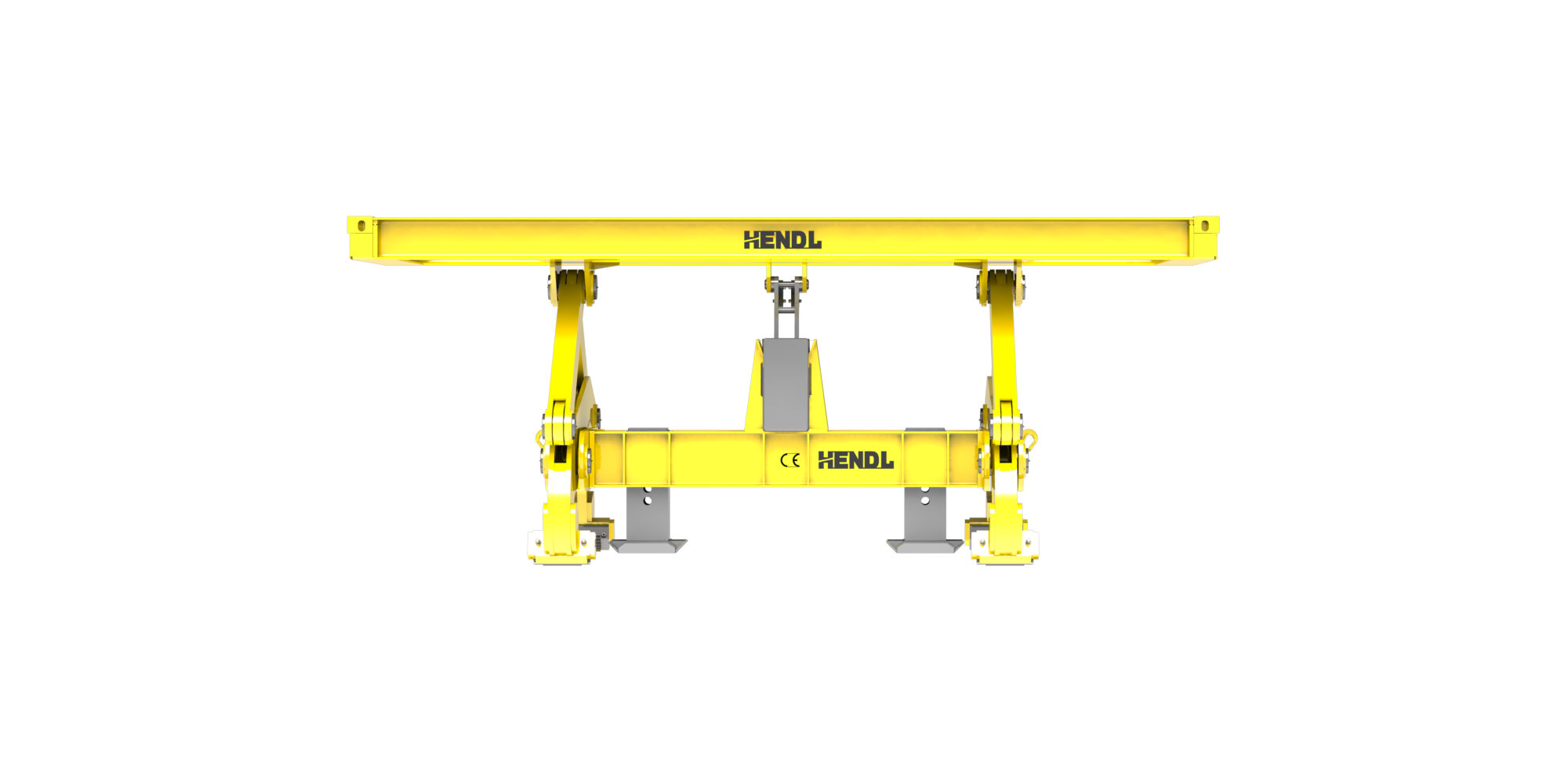
Four-scissor gripping with a contact-actuated central plate and automatic latch for slabs and thick plates. Engineered lifting-machine interfaces.
- Up to 100 t
- Product-family capacity
- Up to 800°C
- Purpose-designed hot-duty versions only
Frame loading
Product introduction
The HENDL Mobile Slab Tong is a mechanical below-the-hook gripping device for lifting slabs and thick metal plates with mobile cranes, overhead cranes or reach stackers. In its four-scissor configuration, and in engineered multi-point variants, hoist force is transmitted through the scissor linkage to grip the load from the sides. A central contact plate touches the slab surface and initiates the automatic latch sequence. The product family covers capacities up to 100 tonnes; higher duties require project-specific engineering.
Standard Capacity And Dimensions
The 100 t figure is an upper product-family capacity, not the WLL of the pictured unit or a guarantee at every gripping width. Handling slabs at up to 800°C is limited to purpose-engineered hot-duty configurations with appropriate material, contact and thermal evaluations. Standard hardened-metal grip tips are not automatically suitable at that temperature. Single/stacked loads, number of scissor mechanisms, latch cycle and lifting interface are model-dependent. The device is not self-propelled and does not use a powered jaw drive or hydraulic gripping system; dimensions and duty cycle are engineered for each project.
Working Principle
The lifting machine lowers the tong onto the slab, where the central contact plate initiates the mechanical opening and closing sequence. As the load is hoisted, the scissor arms grip its sides. After the load has been placed securely on the ground or a suitable support, the automatic latch performs its release sequence. The gripping action is mechanical and requires no external electrical or hydraulic power. The central plate acts as a contact-operated trigger; it is not described as a load-bearing platform unless that function is separately substantiated. Grip security depends on scissor geometry, contact conditions, the load centre of gravity and mechanical retention.
Selection
Specify the slab or thick plate mass, length, width, thickness, surface condition, operating temperature and whether single pieces or stacked slabs will be handled. The mechanical scissor system accommodates load dimensions only within the designed gripping range of the selected model; there is no universal published opening. Single-piece and stacked-load versions require separate grip-point, load-sharing and stability assessments. Suspension for a mobile crane, overhead crane or reach stacker is engineered around the actual hook or interface geometry.
Safety features and engineered options
Depending on configuration, the equipment may incorporate automatic hold-open and release latches, mechanical provisions against unintended release while suspended, scissor travel stops, limits for central-plate movement, secured pin and pivot connections, replaceable wear tips, parking supports and model-specific inspection instructions. Purpose-designed hot-duty versions require additional contact materials and thermal protection. Engineered alternatives include special scissor geometries, independently acting arm groups, replaceable or adjustable central plates, single or stacked slab handling, different crane or reach-stacker interfaces, reduced headroom, centre-of-gravity compensation and maintenance-friendly pins and bushes. These are configuration-dependent features, not standard equipment on every model.
Technical Figures For A Quote
For a quotation, provide the slab or plate material, individual and total mass, length, width, thickness, surface condition and operating temperature. Identify single-piece or stacked handling, stack height, centre of gravity, lift/set-down sequence and expected duty cycle. Include the type and capacity of the mobile crane, overhead crane or reach stacker; hook or interface drawings; available headroom and site restrictions. Attach load drawings and handling layouts where available.
Request a Mobile Slab Tong quotation
Questions
How does a Mobile Slab Tong work, and does it need external power?
It uses the lifting force of the crane to actuate mechanical scissor arms and grip the slab from both sides. A central contact plate triggers the automatic latch sequence. After safe set-down, the latch completes the release cycle. No external electrical or hydraulic supply is required for gripping.
Can every Mobile Slab Tong lift 100 t at 800°C?
No. Up to 100 t describes the product-family capacity, while up to 800°C applies only to separately engineered hot-duty versions. These figures must not be combined into a universal model rating. The actual WLL and temperature suitability depend on load geometry, contact conditions and design verification.
What does “mobile” mean, and how is P020 different from the standard Slab Tong?
“Mobile” refers to engineered compatibility with equipment such as mobile cranes or reach stackers, not to self-propelled travel of the tong. P020 is distinguished by its four-scissor arrangement and a central contact plate that triggers the mechanical latch cycle. The P019 Slab Tong is a separate product family with different gripping and actuation configurations.
Related Equipment
Quote