
INDUSTRIAL TRANSFER SYSTEMS
Industrial Transfer Cart
Rail-Guided, Trackless and Automated Heavy-Load Transport
Powered in-plant transport for coils, dies, slabs, machinery and other heavy industrial loads.
- Up to 200 t
- Product-family capacity
- Up to 10 km/h
- Application-dependent speed
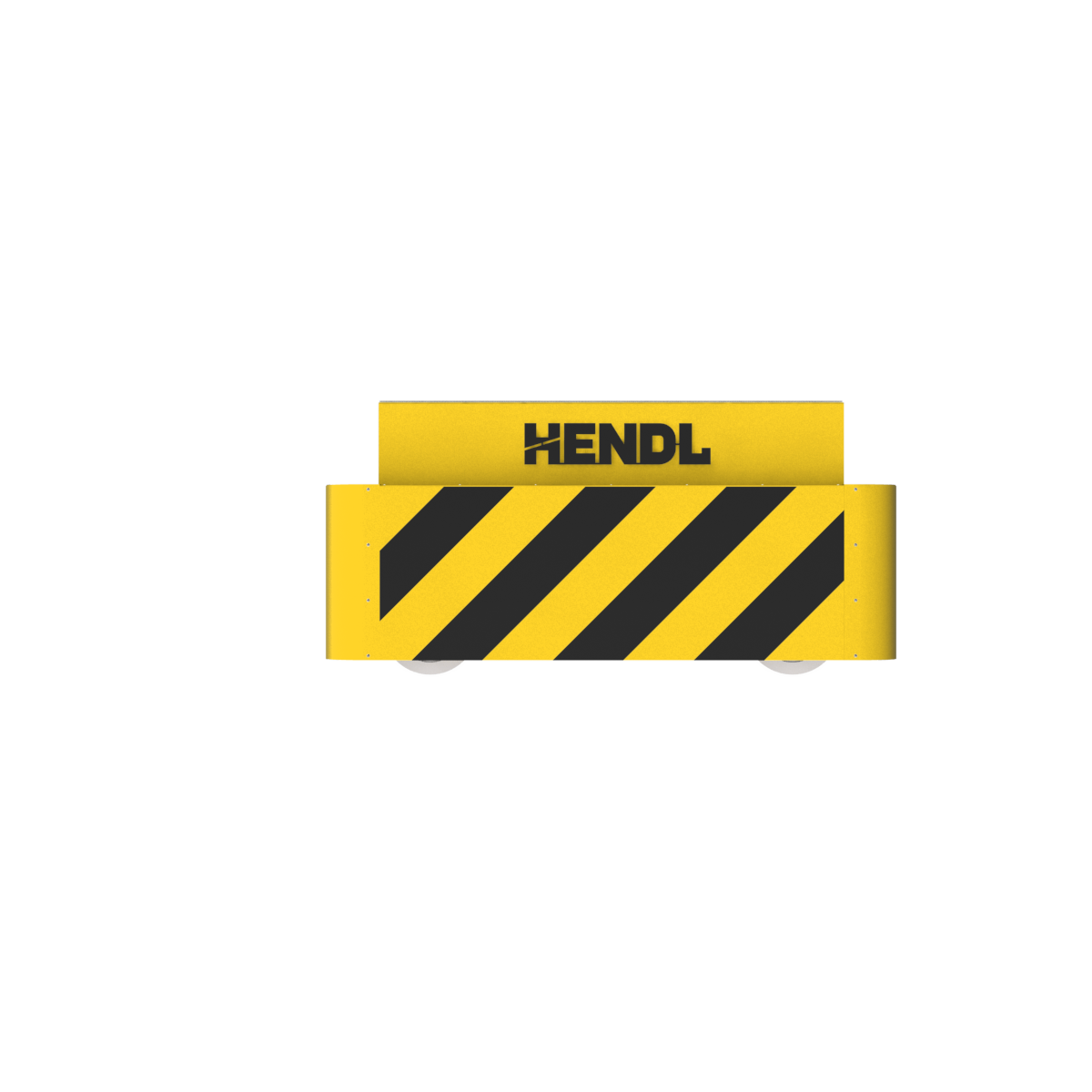
Frame loading
Product introduction
HENDL Industrial Transfer Carts are engineered for moving steel coils, dies, slabs, machinery and other heavy industrial loads between points within a plant. The range includes rail-guided transfer cars, trackless steerable carriers and automated guided configurations as distinct designs. The published product-family capacity is up to 200 metric tonnes, with higher loads assessed individually. Unlike an integrated coil upender and transfer car, this product family is intended for load transport rather than 90° load inversion.
Standard Capacity And Dimensions
Up to 200 t describes the published maximum of the product family, not the capacity of every individual cart.
Travel speeds can be engineered up to 10 km/h depending on the application; this does not mean a 200 t load can be transported at 10 km/h in every facility.
Permitted load and speed must be established together using acceleration and braking performance, wheel and track loads, floor capacity, obstacle sensing, pedestrian access and the site risk assessment.
Deck dimensions, route length, battery capacity and charging cycle, turning radius, lift stroke and duty cycle are project-specific.
Working Principle
Electric motors and gearboxes drive the running gear along the selected route. Rail-mounted versions follow an existing or purpose-designed track. Trackless variants use running wheels and steering mechanisms selected for the floor, turning space and load geometry. Automated guided variants use project-specific route, station and control infrastructure. Cable management, conductor-bar power supply and onboard batteries are alternative arrangements for appropriate models. The deck may be a flat steel platform, a roller-transfer deck or a height-adjustable platform; the latter functions require separate lifting equipment and are not present on all carts.
Selection
Each transfer cart is specified from the payload and centre of gravity, support points, platform dimensions, transfer elevations, travel distance, track gauge or floor capacity, available aisle and turning clearances, station positions and operating duty. Wired or wireless operator controls, automatic station-to-station movement and suitably engineered autonomous guidance are distinct configuration choices. Indoor, outdoor, hot-process and severe-duty environments require dedicated mechanical and electrical provisions. Load cradles or replaceable supports are engineered to keep each payload stable during travel.
Safety and custom engineering options
Application-specific safety functions can include emergency stopping and controlled braking, battery and charging supervision, platform and docking position sensing, overload or drive-torque protection, mechanical load stops, motor braking, controlled slow-down and precise station docking, track end buffers and limits, audible and visual warnings, collision-sensitive bumpers and laser obstacle detection. Engineering options include interchangeable payload supports, electrically or hydraulically lifting decks, roller transfer platforms, powered push-pull load transfer, compact low-deck frames, outdoor and severe-duty designs, cable/conductor-bar/battery variants, conveyor and warehouse integration and automatic or semi-automatic charging. These functions are selected for the relevant configuration and its risk assessment; they are not standard on every variant.
Technical Figures For A Quote
For a quotation, provide the load type, minimum and maximum mass, overall dimensions, centre of gravity, support or restraint points, preferred rail-guided or trackless movement, route and floor drawings, gradients, aisle and doorway dimensions, travel distance, number of stations, transfer elevations, duty cycle, target travel speed, available power infrastructure and automation requirements. Load drawings and a layout of the production area are particularly useful.
Questions
Are rail-guided, trackless and automated guided transfer carts available?
Yes. Rail-guided carts, steerable trackless transporters and automated guided versions are separate engineered configurations. Steering, navigation infrastructure, site conditions and the level of operator or automation control are selected for each project. A single cart is not represented as automatically interchangeable between all three categories.
Can a 200 t payload be moved at 10 km/h?
Not as a universal specification. Up to 200 t is a product-family capacity ceiling; up to 10 km/h is a separate application-dependent travel-speed limit. The allowed combination is determined from braking, vehicle stability, floor or track strength, route conditions and safety assessment.
Can the transfer cart lift a load or turn it through 90°?
The primary function is horizontal transfer. Powered lifting decks and roller-based load transfer are available as project-dependent variants. A 90° coil upending mechanism is not the standard function of P015; the combined rail-transfer and upending application is covered by the separate P014 product family.
Related Equipment
Quote