
Products · Coil And Roll Lifting
COIL LIFTING EQUIPMENT
C-Hook
Steel Coil Lifting Hook
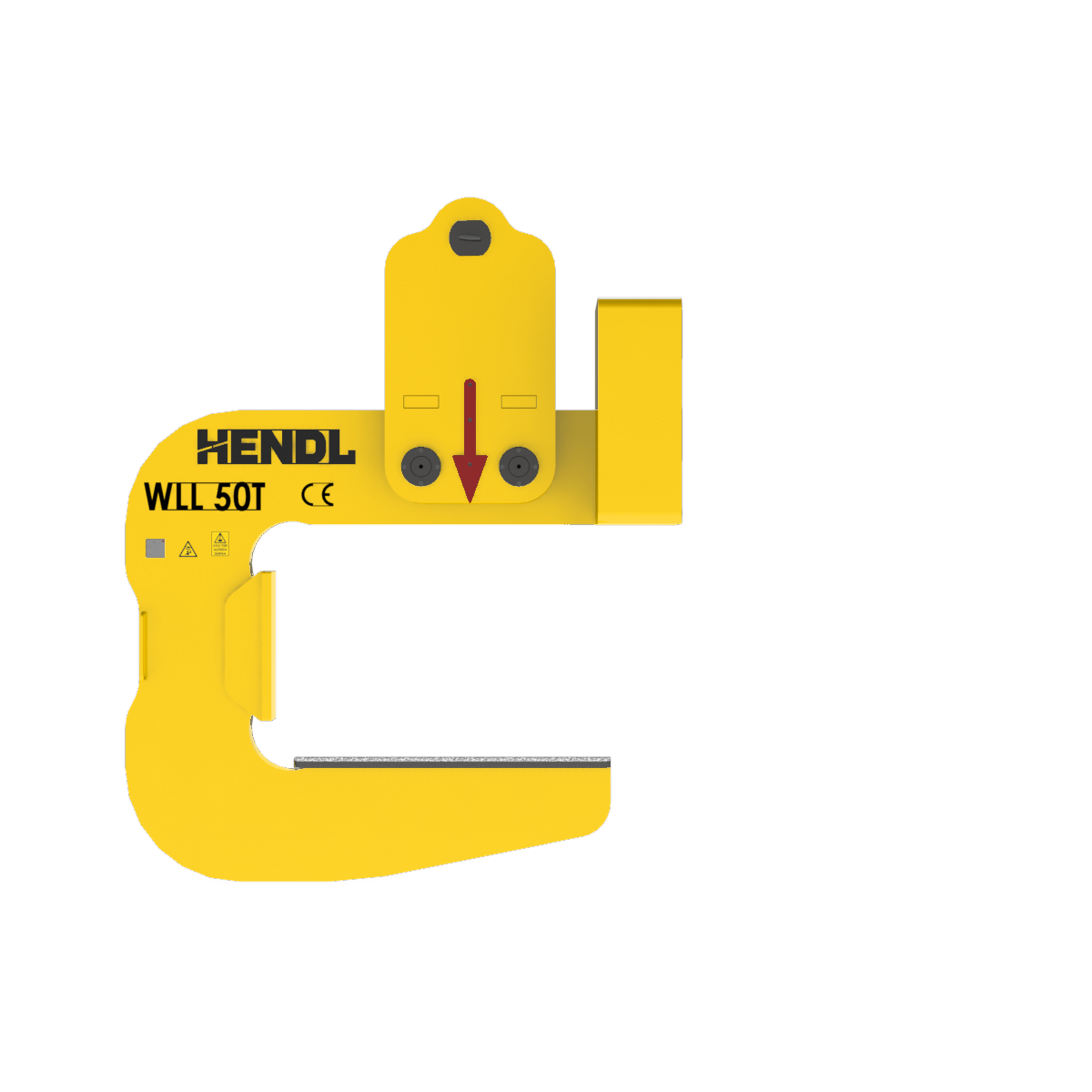
A mechanical C-Hook that supports steel coils through the coil eye, engineered for the required inside diameter and crane connection.
- Up to 50 t
- Lifting capacity
- 300–2,200 mm
- Coil width
Loading frame
Product introduction
The HENDL C-Hook is a mechanical below-the-hook lifting attachment designed to lift and handle horizontally oriented steel and metal coils using an overhead crane. Its lower arm enters the coil eye and supports the load from below, rather than gripping the coil by compression. The product family covers lifting applications up to 50 metric tonnes and coil widths of 300–2,200 mm. Lower-arm geometry, crane attachment and balancing arrangements can be engineered for the coil inside diameter, plant layout and operating requirements.
Standard Capacity And Dimensions
- Lifting capacity
- up to 50 metric tonnes.
- Coil width
- 300–2,200 mm.
- Operating principle
- mechanical support from below by a lower arm inserted through the coil eye.
Lower-arm geometry is adapted to the coil inside diameter.
Pin, lifting-hole or sling suspension arrangements can be engineered to suit the crane interface.
Unloaded and loaded conditions are considered in the balance design.
Protective contact components and handling accessories are application-dependent.
Non-standard sizes and hot-coil applications are subject to custom engineering.
Working Principle
The operator positions the C-Hook at the coil eye using an overhead crane and inserts the lower arm with appropriate clearance for the coil inside diameter. Before lifting, the supporting position of the arm, load centre of gravity, contact areas and crane attachment are checked. The coil is supported and transferred on the lower arm; the attachment does not use powered gripping arms or compression clamping. The unloaded and loaded positions are considered as part of the project-specific geometry and balancing design.
Selection
C-Hook selection considers maximum coil weight, minimum and maximum widths, inside and outside diameters, centre of gravity, coil-eye clearance, lower-arm cross-section and reach, crane hook dimensions, available headroom and storage clearances. The published 50-tonne capacity and 300–2,200 mm width range describe the product family; they do not mean one unit can handle every weight and width combination. Lower-arm geometry is designed for the coil inside diameter, with unloaded and loaded balance assessed for the application. Hot-coil duties require additional evaluation of contact temperature, exposure time and thermal protection.
Protective features and custom engineering options
Polyamide back supports and polyurethane lower-arm coatings can be selected to protect coil contact surfaces. Mechanical stops, replaceable wear plates, guiding handles and storage or transport stands can be provided according to the project. Suspension alternatives include pin, lifting-hole and sling connections. Custom engineering can address different coil inside diameters, unloaded and loaded balance, capacities above 50 tonnes and widths outside the 300–2,200 mm range. Hot-coil applications require a separate assessment of material behaviour, thermal effects and contact surfaces; no universal temperature rating is claimed here.
Technical Figures For A Quote
For a technical quotation, provide maximum coil weight, minimum and maximum widths, inside and outside diameters, load centre-of-gravity or layout information, crane hook or suspension dimensions, available headroom and coil storage arrangement. For hot coils, also specify the approximate coil temperature, contact duration and operating duty cycle. Layout photographs and coil drawings help establish the appropriate lower-arm and balancing configuration.
Questions
What lifting capacity and coil width range does the C-Hook offer?
The HENDL C-Hook family can be engineered for lifting applications up to 50 metric tonnes and coil widths from 300 to 2,200 mm. The appropriate design depends on the actual load, inside and outside diameters, width and crane arrangement. Higher capacities or other widths can be evaluated through custom engineering.
Does a C-Hook clamp the coil, and how is it balanced when unloaded?
No. The lower arm enters the coil eye and supports the load from below; it does not use powered gripping or compression clamping. Unloaded and loaded positions are addressed through the geometry, suspension arrangement and balance design for the particular application.
Can a C-Hook be designed for hot coils and sensitive coil surfaces?
Yes. Polyamide back supports, polyurethane lower-arm coatings and other protective accessories can be considered according to the application. Hot-coil duties require project-specific assessment of temperature, contact duration and material behaviour. No single temperature limit applies to every configuration.
Related Equipment
Quote