
SPECIAL LOAD LIFTING
Spool Lifting Tong
Mechanical under-flange engagement for crane handling of industrial spools
The Spool Lifting Tong is engineered for positive mechanical engagement beneath the upper flange of suitable steel, wooden and plastic spools. Adjustable and project-specific configurations can be evaluated.
- Engineered to order
- Rated lifting capacity
- three or more gripping points
- Positive engagement beneath the upper flange
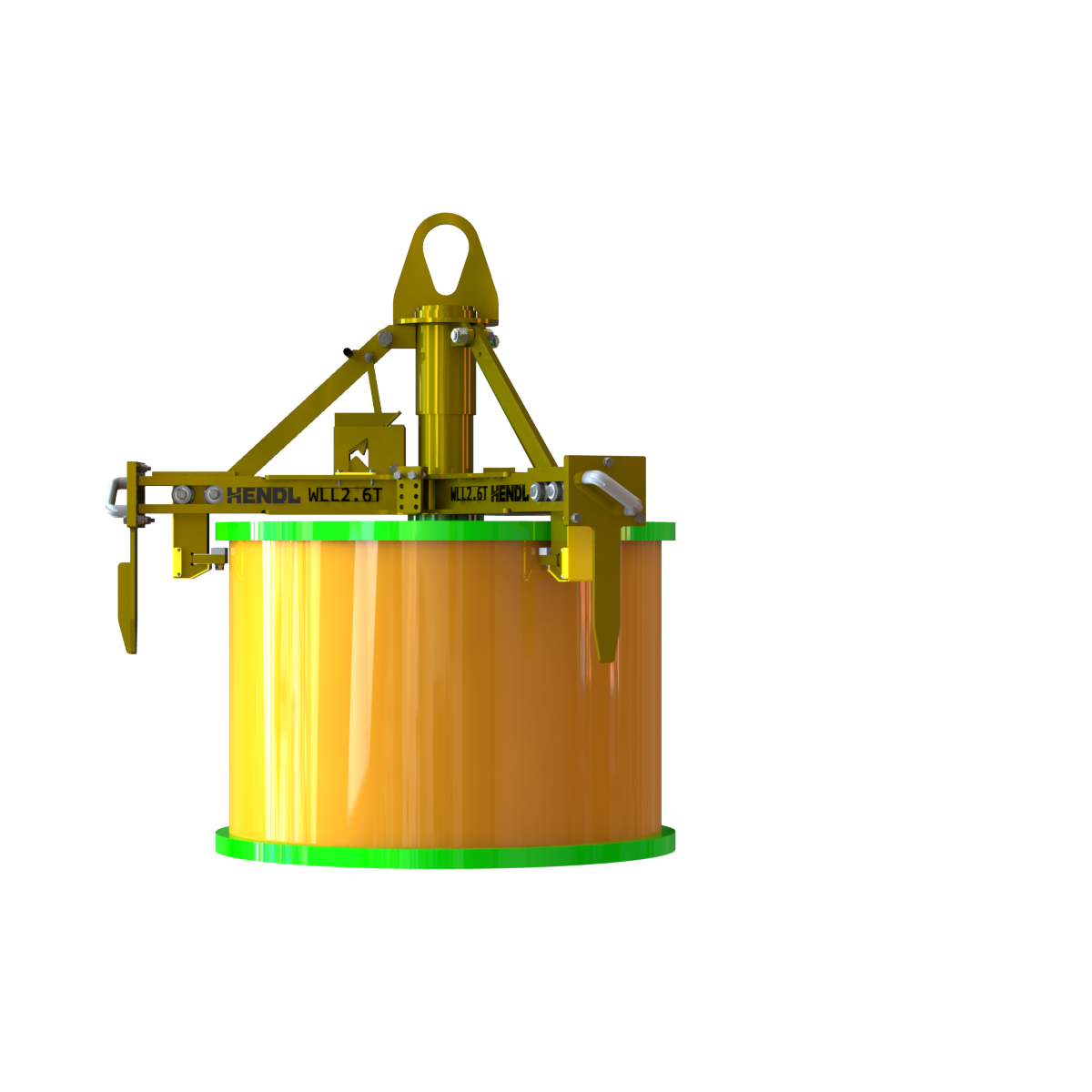
Loading frame
Mechanical engagement beneath the upper spool flange. Engineered for your spool dimensions.
The spool shown is an illustrative load and is not included in the supply.
Product introduction
The HENDL Spool Lifting Tong is a mechanically actuated below-the-hook attachment intended for lifting and handling spools with a vertical axis. Its gripping elements are designed to engage the underside of the upper spool flange. Compatibility with each spool material and geometry is evaluated for the specific application.
The equipment uses a central crane suspension and gripping elements engaging below the upper flange. The design incorporates three or more gripping points. Lifting motion actuates the mechanical gripping arrangement. The suitability and retention of each load configuration are established through project-specific engineering verification, not by a generic product statement.
Standard Capacity And Dimensions
Working load limit (WLL): to be defined and verified for each project. Quote inputs include spool outside diameter, upper flange thickness, spool height, material and a drawing or photograph. Attachment dimensions, self-weight and gripping range will be confirmed during engineering. Numerical capacity markings visible in illustrative media are not product specifications.
An independent mechanical safety lock forms part of the standard design concept. Lock details, load retention, conformity assessment and verification tests must be confirmed in the final engineering design. No specific WLL or CE conformity is claimed before the relevant validation is complete.
Working Principle
The operator positions the attachment over the upper spool flange. The contact points engage the lower edge of the flange, and crane lifting motion actuates the mechanical gripping arrangement. An independent mechanical safety lock is a standard design feature. The operator releases the grip manually only after the spool is fully supported on the ground or another suitable support and lifting tension has been removed.
Engage only flange geometries approved for the specific attachment. Never attempt manual release while the load is suspended. Release the grip only after the spool has been safely landed on a suitable support and crane tension has been removed. Project-specific operating instructions are supplied with the finalized design.
Selection
Handling of cable and wire spools; in-plant industrial spool transfers; warehouse and dispatch operations; suitably designed steel, wooden and plastic spool flanges. The suitability of each material and flange is assessed separately.
Positive engagement beneath the upper flange; three or more gripping points; lifting-motion-actuated mechanism; standard independent mechanical safety lock; manual release after landing; adjustable or made-to-measure configurations.
Defined mechanical engagement at the flange; project-specific dimensional flexibility; central suspension for crane handling; mechanically actuated operation; optional protective contact pads.
Adjustable arrangements for several spool sizes and fixed-geometry attachments for a defined spool family may be engineered. Adjustment range, contact positions, flange thickness and rated capacity are determined from project data.
Vertical-axis spool handling is the standard application. A special configuration for horizontal-axis spools may be evaluated, subject to separate engineering and validation. Protective contact pads are optional.
Technical Figures For A Quote
Share the required WLL, spool outside diameter, upper flange thickness, spool height and material. Please attach a spool drawing or photograph where available to support an application-specific proposal.
Request a lifting solution for your spool
Discuss your spool dimensions and handling process with HENDL to evaluate an application-specific mechanical lifting attachment.
Questions
Which spool materials can be handled?
Steel, wooden and plastic spools may be considered. Flange strength and geometry must be verified for each application.
In which orientation is the spool lifted?
The standard arrangement is intended for vertical-axis spools. Horizontal-axis handling requires separate engineering and validation.
How does the gripping mechanism engage?
Gripping elements are designed to mechanically engage beneath the lower edge of the upper spool flange.
How many gripping points are used?
Three or more gripping points are incorporated; their arrangement is defined for the spool geometry.
Does the attachment need a motor?
The approved base concept is a mechanical arrangement actuated by lifting motion and load effect.
How is the load released?
After the spool is fully supported and lifting tension is removed, the operator opens the gripping arrangement manually.
Can one tong handle different spool diameters?
An adjustable configuration or a made-to-measure design may be evaluated for the required range.
What is the lifting capacity?
WLL is determined and verified for each project. Numerical markings in the illustrative imagery are not product specifications.
Are contact protection pads available?
Optional protective contact pads may be considered depending on the spool material.
Is there an independent safety lock?
An independent mechanical safety lock is part of the standard design concept, subject to final engineering verification.
Is the spool shown included?
No. The spool is an illustrative load and is not supplied with the attachment.
What information is required for a quotation?
Required WLL, spool outside diameter, upper flange thickness, spool height, material and a drawing or photograph.
Related Equipment
Quote