
Products · Plate, Slab And Long Product
PLATE, SLAB & LONG PRODUCTS
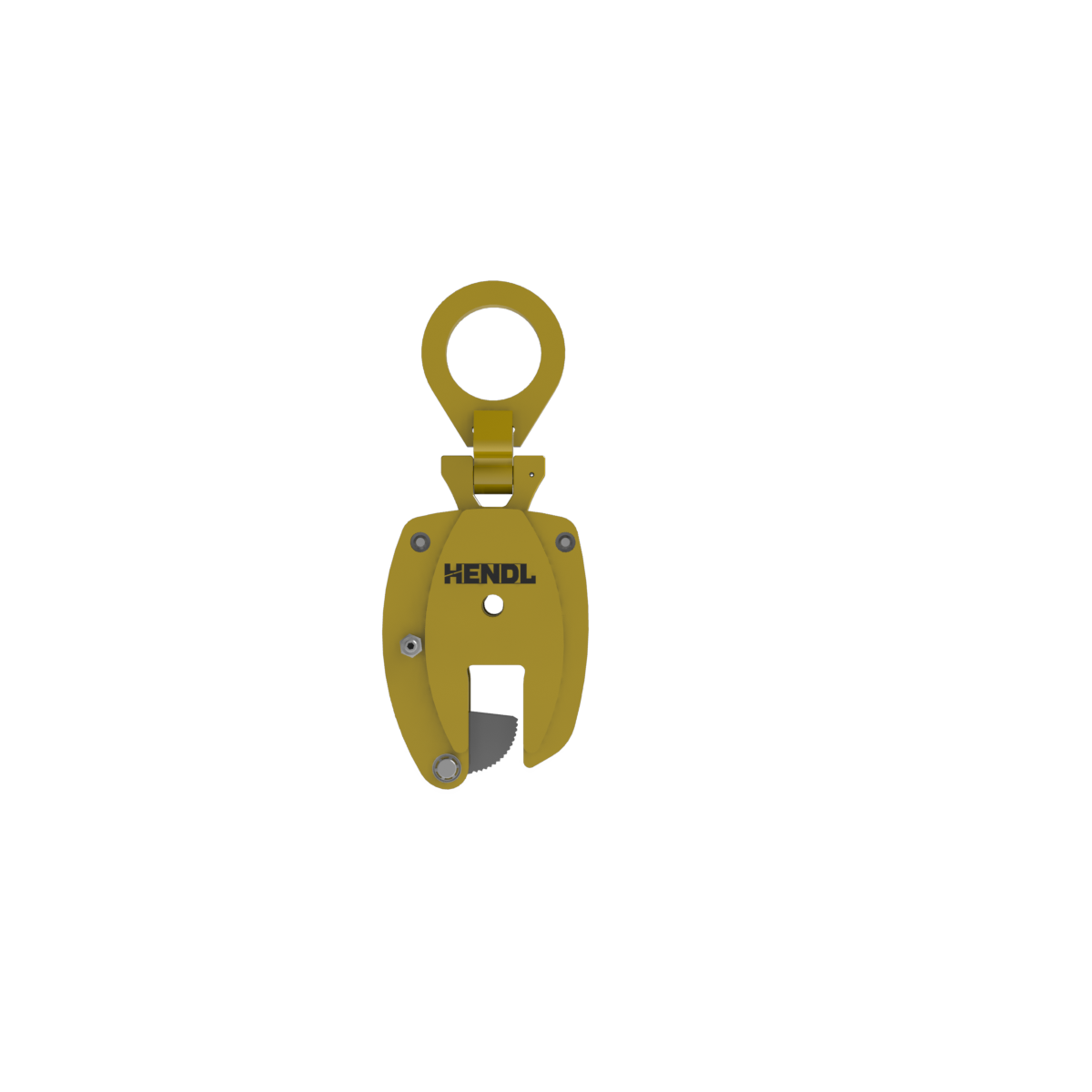
Vertical Plate Lifting Clamp
Vertical plate lifting clamps: 600–5,000 kg WLL and model-specific gripping ranges of 1–101 mm
HENDL vertical plate lifting clamp range: nine standard configurations from 600 kg to 5 t, model-specific plate gripping ranges across 1–101 mm, mechanical safety locking and controlled 180° turning. Custom-engineered versions are available for evaluation.
- 600–5,000 kg
- WLL range · 9 models
- 1–101 mm
- Plate gripping coverage across models
Frame loading
Product introduction
The HENDL range is specified for vertical handling of steel sheet, plate and suitable structural elements. Nine models cover nominal WLL values of 600, 1,000, 2,000, 3,500 and 5,000 kg, each with a defined minimum and maximum gripping opening. The construction uses a swivelling suspension eye with universal joint, a spring-loaded gripping cam and a lockable open/closed safety lever. Intended operations include vertical lifting and controlled turning through 180°. For lateral load inclination, full nominal WLL applies up to 45° and 50% nominal WLL above 45° to 120°. Selection must consider load geometry, centre of gravity, surface and rigging. The manufacturing drawing, weighing record and WLL test report for each model are supplied with the order confirmation.
It is also called a vertical plate clamp, a plate lifting clamp or a steel plate lifting clamp.
Standard Capacity And Dimensions
Standard range: 9 models; WLL 0.6/1/2/3.5/5 t; minimum load 10% of rated WLL. Grip range by model: 1–21, 1–26, 25–51, 1–35, 35–66, 1–36, 35–71, 5–51, 50–101 mm. Standard steel surface hardness ≤300 HB (~32 HRC). Ambient and load temperatures −20 to +100 °C. Lateral inclination ≤45° at 100% WLL; >45° to 120° at 50% WLL. Attachment rotation angle up to 120° each side in its separate rated geometry. Main dimensions are in the model table.
| Model | WLL (kg) | Minimum load (kg) | Plate thickness (mm) | Jaw depth (mm) | Height, closed (mm) | Eye inner diameter (mm) | Approx. weight (kg) |
|---|---|---|---|---|---|---|---|
| P043-0600-001-021 | 600 | 60 | 1–21 | 50 | 256 | 50 | 1.8 |
| P043-1000-001-026 | 1000 | 100 | 1–26 | 64 | 317 | 60 | 3.8 |
| P043-1000-025-051 | 1000 | 100 | 25–51 | 64 | 316 | 60 | 4.1 |
| P043-2000-001-035 | 2000 | 200 | 1–35 | 85 | 399 | 80 | 6.7 |
| P043-2000-035-066 | 2000 | 200 | 35–66 | 85 | 399 | 80 | 7.3 |
| P043-3500-001-036 | 3500 | 350 | 1–36 | 85 | 459 | 85 | 12.6 |
| P043-3500-035-071 | 3500 | 350 | 35–71 | 85 | 466 | 85 | 13.9 |
| P043-5000-005-051 | 5000 | 500 | 5–51 | 110 | 581 | 85 | 22.9 |
| P043-5000-050-101 | 5000 | 500 | 50–101 | 110 | 590 | 85 | 25.8 |
Scroll the table sideways on a phone.
Plate thickness is the thinnest and thickest plate the model grips. Weights are approximate. The fully dimensioned manufacturing drawing, weighing record and WLL test report are supplied with the order confirmation.
Nominal WLL values: 600, 1,000, 2,000, 3,500 and 5,000 kg across nine variants; minimum load 10% of nominal WLL (60–500 kg). Apply the inclination derating separately.
Individual gripping ranges: 1–21; 1–26; 25–51; 1–35; 35–66; 1–36; 35–71; 5–51; and 50–101 mm. The full 1–101 mm coverage belongs to the family, NOT one continuously adjustable clamp.
Capacity By Angle
| Angle type | Angle range | Permitted load |
|---|---|---|
| Lateral pull angle | 0–45° | 100% WLL |
| Lateral pull angle | Over 45° – 120° | 50% WLL |
| Attachment (suspension eye) angle | Up to 120° each side | 100% WLL · separate geometry |
The lateral pull angle and the attachment angle of the suspension eye are different geometries; their values are never combined. Example: a 2,000 kg WLL model carries at most 1,000 kg at a 60° lateral pull. Lateral pull beyond 120° is not used.
Working Principle
The clamp grips the edge of a compatible plate. A spring-loaded gripping cam and safety lever with open/closed locking positions resist accidental release. The swivelling eye aligns with the approved rigging arrangement; verify thickness, load weight and locking status before each lift.
Selection
The standard range is for suitable steel plate and structural components up to 300 HB (approximately 32 HRC) surface hardness. Stainless steel and extra-hard plates require separately engineered gripping versions. Never assume oily, painted, slippery or delicate finishes are compatible.
Nine standard variants with WLL from 0.6 to 5 t and family-wide plate coverage 1–101 mm. Adapted grippers for stainless or hard steel and custom WLL/openings can be evaluated.
Safety And Use
Minimum load 10% of rated WLL. Lateral inclination: full WLL at 0–45°, half WLL above 45° up to 120°. Do not confuse the attachment-eye rotation angle with lateral load inclination. For long loads assess two clamps on a two-leg sling or lifting beam. Temperature, hardness, turning and safety lock operating limits must be confirmed on the released HENDL model.
Inspect gripping surfaces, pins, moving parts and lifting connections before use. Conduct periodic inspections in line with the manufacturer’s instructions and applicable regulations.
Key Features
- Nine configurations across 600–5,000 kg WLL
- Gripping ranges collectively covering 1–101 mm
- Vertical lifting and controlled 180° plate turning
- Swivelling universal-joint suspension eye
- Lockable open/closed spring-loaded gripping mechanism
- Custom capacities, openings and special plate material options
Applications
Vertical lifting and controlled 180° turning of steel sheets, plates, suitable beams and steel structural parts in service centres, fabrication workshops and material stores.
- Steel service centres
- Sheet metal processing and laser cutting
- Machinery and steel fabrication
- Metalworking and manufacturing
- Warehouse and intralogistics
Technical Figures For A Quote
Share the load weight, plate thickness and lifting application to request a suitable standard or custom-engineered solution.
Questions
What is vertical plate lifting?
It is the lifting of a steel plate in a vertical orientation using a suitable mechanical edge-gripping clamp and crane.
Where is this clamp used?
For vertical lifting, transfer and positioning of steel plates in storage and manufacturing operations.
What rated capacities are planned?
Nine variants cover WLL ratings of 600, 1,000, 2,000, 3,500 and 5,000 kg. Each variant requires a minimum load of 10% of its WLL.
What plate thickness can be gripped?
Variant ranges are 1–21, 1–26, 25–51, 1–35, 35–66, 1–36, 35–71, 5–51 and 50–101 mm. The total 1–101 mm span is not one continuously adjustable clamp.
Can the clamp be made to custom dimensions?
Yes. Application-specific capacities, gripping ranges and configurations can be assessed by engineering.
Can stainless or hardened steel be lifted?
The standard models apply to appropriate steel up to 300 HB (~32 HRC) surface hardness. Stainless or harder material needs a separate engineered gripping option.
Can a plate be turned through 180°?
Yes. Controlled 180° turning is possible with suitable rigging and the operating instructions supplied with the clamp.
What does the 120° angle mean?
Attachment-eye rotation and lateral load inclination are different. Lateral inclination permits 100% WLL up to 45°, then 50% WLL above 45° through 120°. The attachment rotation allowance does not override this derating.
Should I use one or two clamps?
For long plates, two clamps on a two-leg sling or lifting beam are generally assessed; final selection depends on load dimensions, centre of gravity and rigidity.
Is there a minimum load?
Yes: 10% of the nominal WLL, equal to 60, 100, 200, 350 or 500 kg depending on the variant.
How is the clamp documented for EN 13155 and CE?
EN 13155 is the European standard that sets safety requirements for non-fixed load lifting attachments used with cranes and hoists. HENDL vertical plate lifting clamps are designed and manufactured on the basis of EN 13155 and delivered with CE marking and an EU declaration of conformity. The manufacturing drawing, weighing record, WLL test report, operating manual and marking details are supplied with the order confirmation.
What do you need for a quotation?
Load weight, plate thickness and dimensions, material/surface details, lift geometry, quantity and any special conditions.
 Slab Tong
 Mobile Slab Tong
 Adjustable Lifting Beam
Quote